Run Forrest Run Funny Lemur Holding Up Hand
Lemurs: A diverse grouping of endangered primates
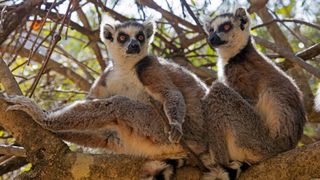
Lemurs are a unique grouping of primates native to Madagascar, an island off the declension of due east Africa. Although they are related to monkeys and apes, lemurs make upwardly a separate branch of the primate family tree and are classified as a superfamily, made up of five individual lemur families and more than 100 different species.
Lemurs have pointed snouts with wet noses and rely more on their sense of odour than monkeys do, co-ordinate to the Lemur Conservation Foundation (opens in new tab). The lemur superfamily includes ring-tailed lemurs (Lemur catta) popularized by the "Madagascar" moving-picture show franchise, and the peculiar yep-ayes (Daubentonia madagascariensis) — previously described by Live Science equally "and then ugly it'south beautiful (opens in new tab)." Lemurs' appearance, nutrition and habitat vary betwixt the different species, only each one plays a role in the rich and varied ecosystems of Republic of madagascar.
After a 2012 assessment of the earth's lemur population, the International Spousal relationship for Conservation of Nature (IUCN) called lemurs the most endangered mammals on Earth, Live Scientific discipline previously reported (opens in new tab). Almost all of the lemurs alive today are threatened with extinction, according to the IUCN (opens in new tab).
Types of lemur
In that location are 113 known lemur species, according to the IUCN (opens in new tab), with the potential for more to be discovered. Indri (Indri indri) is the largest lemur species, and can grow to between 24 and 35 inches (61 and 90 centimeters) long and can weigh up to 22 lbs. (x kilograms), according to the Zoological Club of London (ZSL) (opens in new tab). Lemurs ofttimes have long tails, but indris are the only species to not accept one at all.
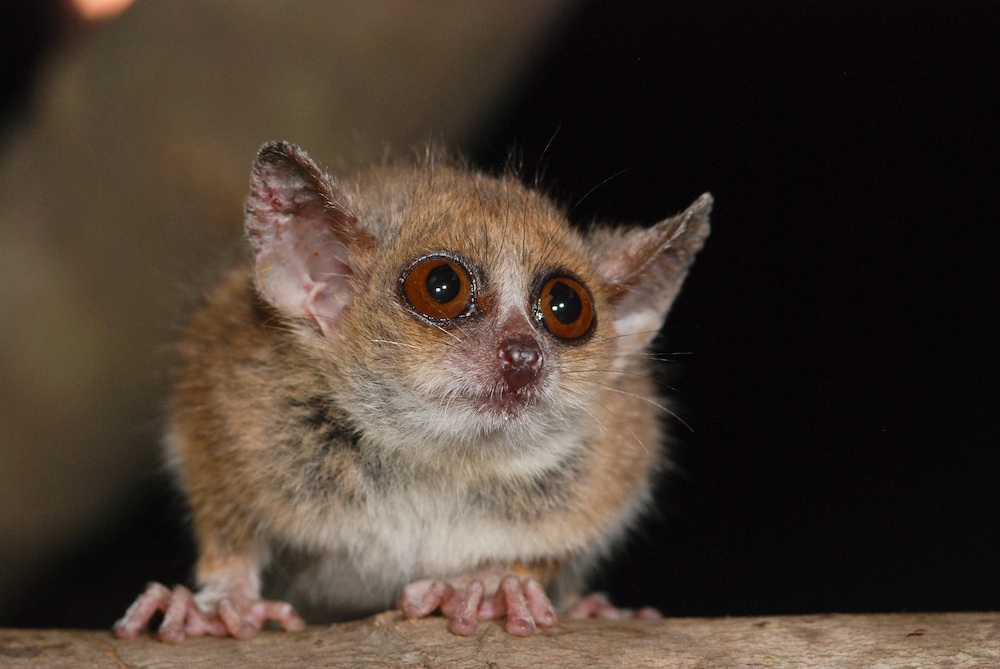
The smallest lemurs are Madame Berthe'southward mouse lemurs (Microcebus berthae), which are besides the smallest primates in the world. These lemurs grow to just 3.5 to four inches (9 to 11 cm) long excluding their tails, which add some other 5 to vi inches (12 to fourteen cm) to their length. The tiny lemurs just weigh an boilerplate of 1 ounce (thirty grams), according to the University of Michigan's Animal Diversity Web (ADW) (opens in new tab).
Behemothic lemurs, some the size of gorillas (opens in new tab), roamed Republic of madagascar just a few yard years ago. These included behemothic sloth lemurs, which had long limbs and hooked fingers like the claws of a modernistic sloth, although they were lemurs and not sloths, which are a separate grouping of mammals. Behemothic sloth lemurs were still living in Madagascar until at least 1,000 years ago, as evidenced past a unmarried cavern drawing of a giant sloth lemur existence hunted by humans with dogs, according to The Natural History Museum (opens in new tab) in London.
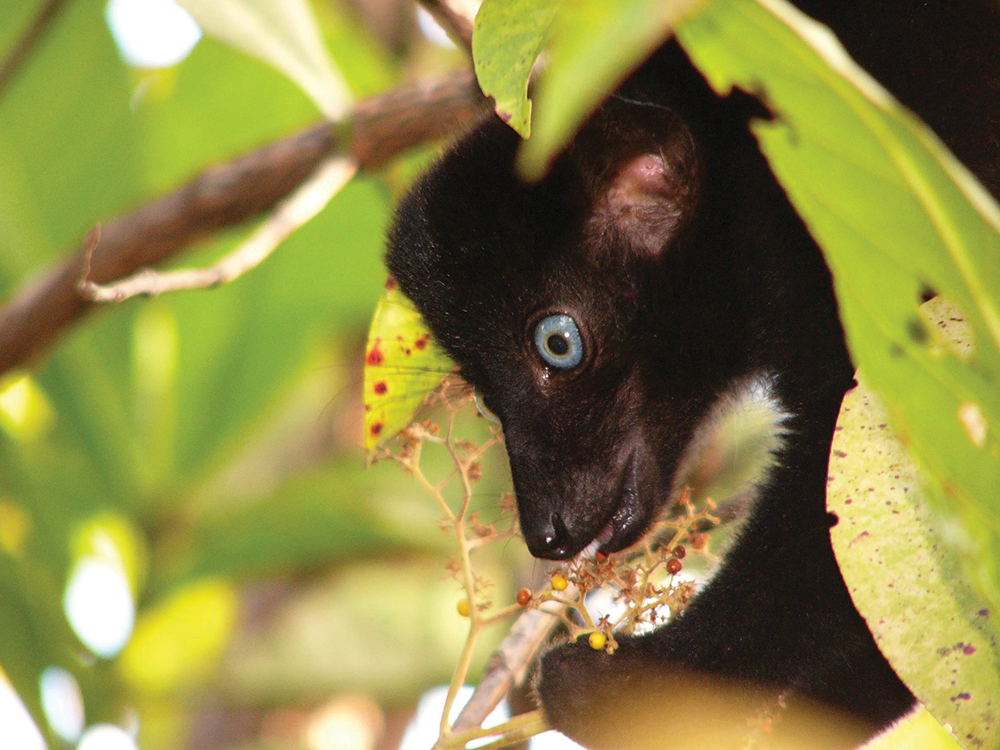
Size is non the only way to tell lemur species apart — they are oft as well very unique in appearance. Ring-tailed lemurs are easily recognized by the blackness rings on their white, fluffy tails. Blue-eyed black lemurs (Eulemur flavifrons) are hitting, as they are the only primates other than humans to accept blue eyes, co-ordinate to the San Diego Zoo (opens in new tab). Aye-ayes have peradventure the strangest advent of all lemurs and primates in full general, with tiny, bulging optics, enormous ears and fluffy, long tails. These nocturnal lemurs also take long, skinny fingers that they tap on branches to locate and collect grubs for food.
Related: 'Cursed' primate weirdos have extra thumbs. Scientists didn't know well-nigh them until at present (opens in new tab)
Where do lemurs live?
All lemurs are found on Republic of madagascar, an island land off the w coast of Africa in the Indian Sea. Populations of mongoose lemurs (Eulemur mongoz) and brown lemurs (Eulemur fulvus) likewise live on the nearby Comoros Islands, betwixt Republic of madagascar and Mozambique, only they were almost certainly introduced to these islands by humans, according to the IUCN (opens in new tab).
Related: Species hitched ride to Madagascar on floating islands (opens in new tab)
Lemur Taxonomy
Kingdom: Animalia
Phylum: Chordata
Class: Mammalia
Order: Primates
Superfamily: Lemuroidea
Lemurs occupy many different habitats on Madagascar, including rainforests (opens in new tab), dry deciduous forests, spiny forests, wetlands and mountains. For instance, Sibree's dwarf lemurs (Cheirogaleus sibreei) alive in rainforests at altitudes to a higher place 4,590 feet (1,400 meters), and white-collared lemurs (Eulemur cinereiceps), besides known as grayness-headed lemurs, live in a thin strip of tropical, moist lowland forest from sea level up to 2,950 feet (900 m). Lemur habitat is disappearing due to deforestation and their ranges are ofttimes highly restrictive.
Some animals, such every bit Sunda flying lemurs (Galeopterus variegatus) from Southeast Asia, take lemur in their name only are not actually lemurs. Truthful lemurs are only found on Madagascar and nearby islands.
What do lemurs swallow?
Many lemurs are herbivores and feed on fruit, flowers, tree bark and sap. Lemurs can be very picky nigh what they eat, with most of their diet coming from a few tree species, according to the American Museum of Natural History (AMNH) (opens in new tab). For example, greater bamboo lemurs (Prolemur simus) are highly specialized to eat bamboo, making them Republic of madagascar'south equivalent of China's giant pandas (opens in new tab) (Ailuropoda melanoleuca). A 2017 report published in the periodical Current Biology (opens in new tab) found that greater bamboo lemurs living in Republic of madagascar's Ranomafana National Park go almost all of their food from a single species of woody bamboo chosen Cathariostachys madagascariensis.
Lemurs are key seed dispersers on Madagascar, which means they help plants reproduce by carrying seeds in their breadbasket after eating fruit and depositing the seeds into a new area through their carrion. Certain plants tin can exist dependent on a unmarried lemur species to disperse their seeds. For case, a 2013 written report published in the Periodical of Tropical Ecology (opens in new tab) noted that brown lemurs in a tropical dry out forest in northwestern Madagascar are the just disperser for plants with seeds that are more than than 0.4 inches (10 millimeters) in diameter. These characteristics make lemurs important for maintaining healthy forests, just as healthy forests are important for providing lemurs with food.
Some lemurs are omnivores and will also eat insects and small vertebrates. Ring-tailed lemurs, for instance, will feed on anything that is easily available to them, and their diet can include spiders (opens in new tab), chameleons (opens in new tab) and even small-scale birds, according to ADW (opens in new tab).
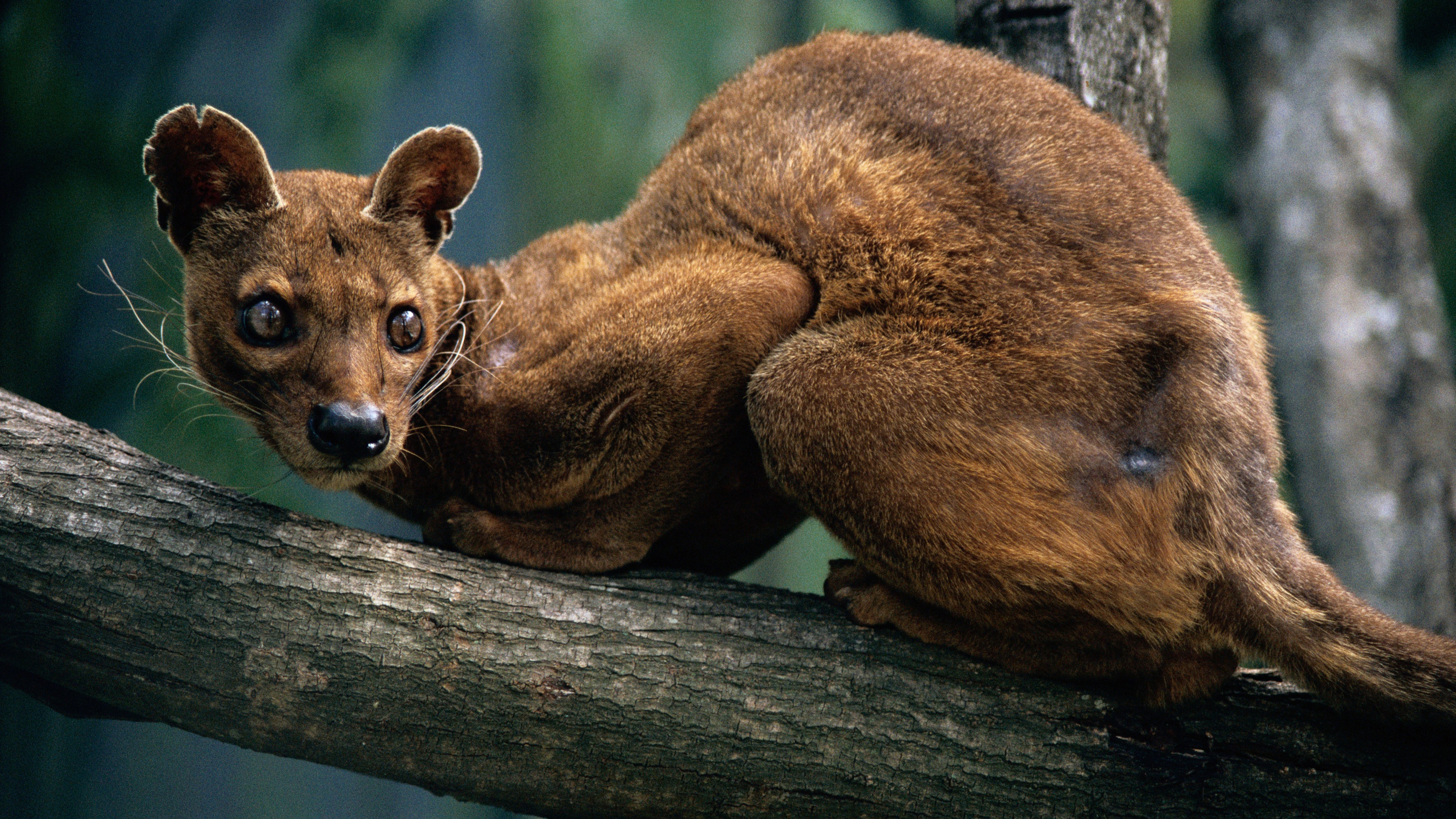
Lemurs' main predators are fossas (Cryptoprocta ferox) — carnivores that looks a bit like a cat or weasel. Lemurs tin as well become prey for large snakes, birds, humans and animals humans have introduced to Madagascar, such as domestic cats.
Activeness patterns
Lemurs can be diurnal (active during the mean solar day), nocturnal (active at night), or cathemeral (active during the day and dark), depending on the species, according to the Duke Lemur Heart (opens in new tab), a research foundation in North Carolina. The time of day cathemeral lemurs, such as brown lemurs, cull to be awake and active tin too depend on atmospheric condition, season and what foods are available to them.
A few lemur species hibernate, such equally fatty-tailed dwarf lemurs (Cheirogaleus medius). They can hibernate for up to seven months during the dry season when nutrient is more than scarce. Fat-tailed dwarf lemurs usually spend this dormant flow in hollowed-out tree trunks and survive off fat reserves stored in their tails, according to the Duke Lemur Center (opens in new tab).
Band-tailed lemurs warm upward after a absurd night by basking in the warm morning sunshine, according to Bristol Zoo Gardens (opens in new tab) in the U.M. They often sunbathe past sitting upright with their arms spread wide, making information technology appear every bit though they are worshipping the sun. Other lemur species, including blackness-and-white ruffed lemurs, besides sunbathe to warm up.
Related: Lemurs snooze in caves like early on humans (opens in new tab)
Lemur life
Lemurs that are active during the mean solar day are highly social and live in family unit groups known as troops. This allows them to alarm each other to predators. Nocturnal lemurs, on the other paw, apply the cover of darkness to assist them hide from predators, according to the San Diego Zoo. However, lemurs take complex social lives and even solitary species may sleep together.
A 2005 study published in the International Journal of Primatology (opens in new tab) found that nocturnal Madame Berthe'southward mouse lemurs spent half of their nights sleeping alone and the other one-half sleeping in groups, which is similar to other mouse lemurs. Sleeping in groups may help largely solitary lemurs stay warm and provide protection against predators that could chase them while they are resting. Sahamalaza sportive lemurs (Lepilemur sahamalaza) rest and sleep alone, but they use the warning calls of birds and other lemurs to know when predators are nearby, co-ordinate to a 2013 report published in the journal PLOS One (opens in new tab).
All lemur species apart from aye-ayes take a tooth comb — six teeth fused together at the front of their lower jaw to groom themselves and other lemurs. They also take a secondary tongue under their primary natural language chosen a sublingua, which they use to clean the tooth comb like a toothbrush, according to the Knuckles Lemur Eye (opens in new tab).
Related: Lemur faces are unique, facial recognition reveals (opens in new tab)
Scent is very important when information technology comes to lemur mating. Male person ring-tailed lemurs "stink flirt" with females by rubbing aromatic chemicals secreted from their wrists onto their tails and waving their tails effectually in the presence of females. The secreted liquid smells bitter and leathery to the man olfactory organ for well-nigh of the twelvemonth merely becomes more fruity, floral and sweet during the convenance season from Apr to May, Live Science previously reported (opens in new tab). The alter in smell could be a sign for females that a male is set to mate. Male lemurs also apply their smelly tails to have stink fights with rival males when competing for the opportunity to breed with females, past seeing who has the strongest scent.
After mating, female lemurs take a gestation period of 102 to 170 days, depending on the species. A female person can give birth to betwixt one and six young at a time. Smaller species of lemurs tend to give birth to more than babies, co-ordinate to the San Diego Zoo.
Baby lemurs, chosen pups, generally cling to their mother's belly for the first three to four weeks of life and then ride on her back until they are 3 to 4 months old. Lemurs can take between one and three-and -a-half years to achieve machismo, depending on the species. The lifespan of lemurs depends on the species likewise. According to ADW, gray mouse lemurs (Microcebus murinus) live an boilerplate of xiv years in captivity; ring-tailed lemurs usually live 16 years in the wild simply may accomplish 33 years quondam in captivity; and black-and-white ruffed lemurs (Varecia variegata) tin live for more than 35 years in captivity.
Can you take a lemur as a pet?
Lemurs are occasionally kept as pets in the U.S., only many scientific discipline and conservation organizations, such equally the Duke Lemur Center (opens in new tab) and the Lemur Conservation Foundation (opens in new tab), oppose the exercise. Lemurs naturally live in complex social groups and are non suited to living with humans in a domestic setting. Pet lemurs also accept a strong, unpleasant odor, and often become ambitious when they reach sexual maturity.
A 2019 report published in the journal PLOS One (opens in new tab) estimated that more than 30,000 wild-caught lemurs were being kept equally pets in Madagascar. The written report noted that ane-third of attempts to proceed pet lemurs resulted in the death of the lemur and in one case they are kept equally pets, it's near impossible to render them to the wild. The motivation for capturing wild lemurs ofttimes comes from the tourism industry.
"Tourists love to see lemurs up close and are often willing to pay seemingly minor amounts of money to collaborate or accept selfies with lemurs, particularly baby lemurs," Marni LaFleur, an assistant professor at the Academy of San Diego and co-lead writer of the study, said in a statement (opens in new tab) at the time. "These superficially harmless behaviors, all the same, in part fuel the illegal extraction of lemurs from the wild and are detrimental to the wellbeing and survival of wildlife globally."
Conservation condition
In 2020, the IUCN (opens in new tab) announced that 98% of all lemurs are threatened with extinction. The main reasons lemur populations take declined so significantly is because of habitat loss due to deforestation (opens in new tab) and hunting in Madagascar. Their habitat is oftentimes destroyed so that it tin can be used for agriculture, and they are hunted for food.
Related: More than one-half of all primates threatened with extinction (opens in new tab)
IUCN data (opens in new tab) show that 31% of lemur species are listed as critically endangered, which is just one category away from extinction in the wild. Critically endangered lemur species include indris, blackness-and-white ruffed lemurs, Sibree's dwarf lemurs, blue-eyed black lemurs and mongoose lemurs.
Over 40% of the remaining species of lemurs, including ring-tailed lemurs and yes-ayes, are listed equally endangered by the IUCN, and another 20% are classified as being vulnerable to extinction. Grayness mouse lemurs and gray-brownish mouse lemurs (Microcebus griseorufus) are the only lemur species that are currently not threatened with extinction and are placed in the lowest-run a risk category. Even so, the IUCN notes that even these species are probable in reject and may be moved into the threatened category in the future. Finally, Groves' dwarf lemurs (Cheirogaleus grovesi) and Nosy Boraha mouse lemurs (Microcebus boraha) are listed equally data deficient, which means there isn't enough data about their populations for the IUCN to make an assessment.
Boosted resources
- Illustrated book: "Lemurs of Republic of madagascar" (Conservation International, 2010) (opens in new tab). Available to buy at Amazon.
- The Lemur Conservation Network (opens in new tab) website offers more than data about lemur conservation.
- The American Museum of Natural History (opens in new tab) website has a short moving picture about lemurs.
This article was originally written by Alive Science correspondent Alina Bradford and has since been updated.
Source: https://www.livescience.com/55276-lemurs.html
0 Response to "Run Forrest Run Funny Lemur Holding Up Hand"
Enregistrer un commentaire