Melanie Charless Make Jazz Trill Again Project
The legendary Set Free Richardson once said that basketball "is the sound of a drum." Those words, spoken by the creative visionary who in one case spearheaded marketing campaigns for AND1, reflect merely how undeniably cute of an art form the game truly is: it's not just a sport, or poetry in motion, information technology'due south a limerick of music—and out there on the hardwood, or the blacktop, every player is uniquely orchestrating their own symphony or mixing and looping in their ain beats and samples. While Set Costless was referring to the vanquish in hip-hop, specifically, the game has often been connected to another genre as well: jazz music.
Hither's a history lesson for you: Long earlier the NBA was established in 1946, there was a flow known as the "Black Fives Era" that marked a time in which Black basketball game leagues and teams were being formed all across New York and Chicago, from the Alpha Large Five to the Savoy Big Five (who would later get the Globetrotters, and then renamed the Harlem Globetrotters). Because many players of color were "barred" from competing in white-only clubs and gymnasiums, they hooped in church basements and even ballrooms instead, oftentimes with jazz music and dances taking place before and after games. Don't sleep though, the Globetrotters were certified buckets and entertainers all in i: two years before professional basketball game became desegregated, they beat the Minneapolis Lakers off a buzzer beater in 1948. A twelvemonth later, in 1949, their iconic theme song "Sweet Georgia Brown" by the Brother Bones (originally released in 1925) became a top-10 hit on the radio.
All the while, jazz has connected to go intertwined in every aspect of the game as nosotros know it today: the Utah Jazz, who were originally founded in New Orleans in 1974, decided on the Jazz as its mascot because of the city'due south deep connexion to the art form. Then there'southward its influence on the players themselves—the late-Wayman Tisdale, who was a standout at Oklahoma and has the USBWA's National Freshman of the Year award named later him, even pursued a music career later playing 12 years of pro ball, and in 1995 his debut album reached No. 4 on Billboard's jazz music charts.
So yeah, if yous didn't know then, then you certainly should know now that jazz is for the civilisation. Remember that Nike commercial from 2017, where Kyrie Irving is literally performing to the tempo of the drums, played by Questlove? In that location information technology is, the two worlds colliding.
The connection between the two fine art forms has inspired visionaries like Melanie Charles, a Brooklyn-born vocalist, songwriter, dancer and composer that experiments with jazz, soul and Haitian-rooted music. "The fact that information technology wasn't a Black man that created basketball game is so interesting. I feel like we took over the sport and fabricated it our own," Charles says on Zoom. "And that same matter with jazz—I'g not saying anyone invented jazz considering it'due south a fusion of then many things, but it is definitely the people of colour who have always shifted it and evolved the sound. It's considering of our soul. It has that extra thing that we have that makes it [where] when we're going to play the blues, it's going to sound this way. And we play ball, I hateful the Greek Freak is the Greek Freak but he's still a brother."
Charles, whose mother is a Hatian immigrant and loved Frank Sinatra, Nat Male monarch Cole and Ella Fitzgerald, attended LaGuardia High School for the Performing Arts in New York City equally a flute major and went on to attend The New School for Jazz and Contemporary Music. Her work is non just compelling, but honors the jazz legends that came before her, all while intertwining her ain unique sound to reflect the Black experience. On her showtime anthology, The Girl With the Dark-green Shoes, Charles reimagined Nancy Wilson's "How Glad I Am" by calculation a more than soulful R&B "groove" to it, and while working on her side by side project, Y'all Don't (Really) Care About Black Women, which came out this past November, Charles was encouraged by her tape label, Verve Records, to go on putting her ain twist on records from their catalog. The consequence is a body of work that includes songs like "Starting time to See the Light (Reimagined)" "God Bless the Child," and especially "Jazz (Ain't Nothing But Soul) [Reimagined]"—a funky, soulful bops that an older crowd tin can mess with, along with a trounce driblet that younger generation will certainly vibe out to.
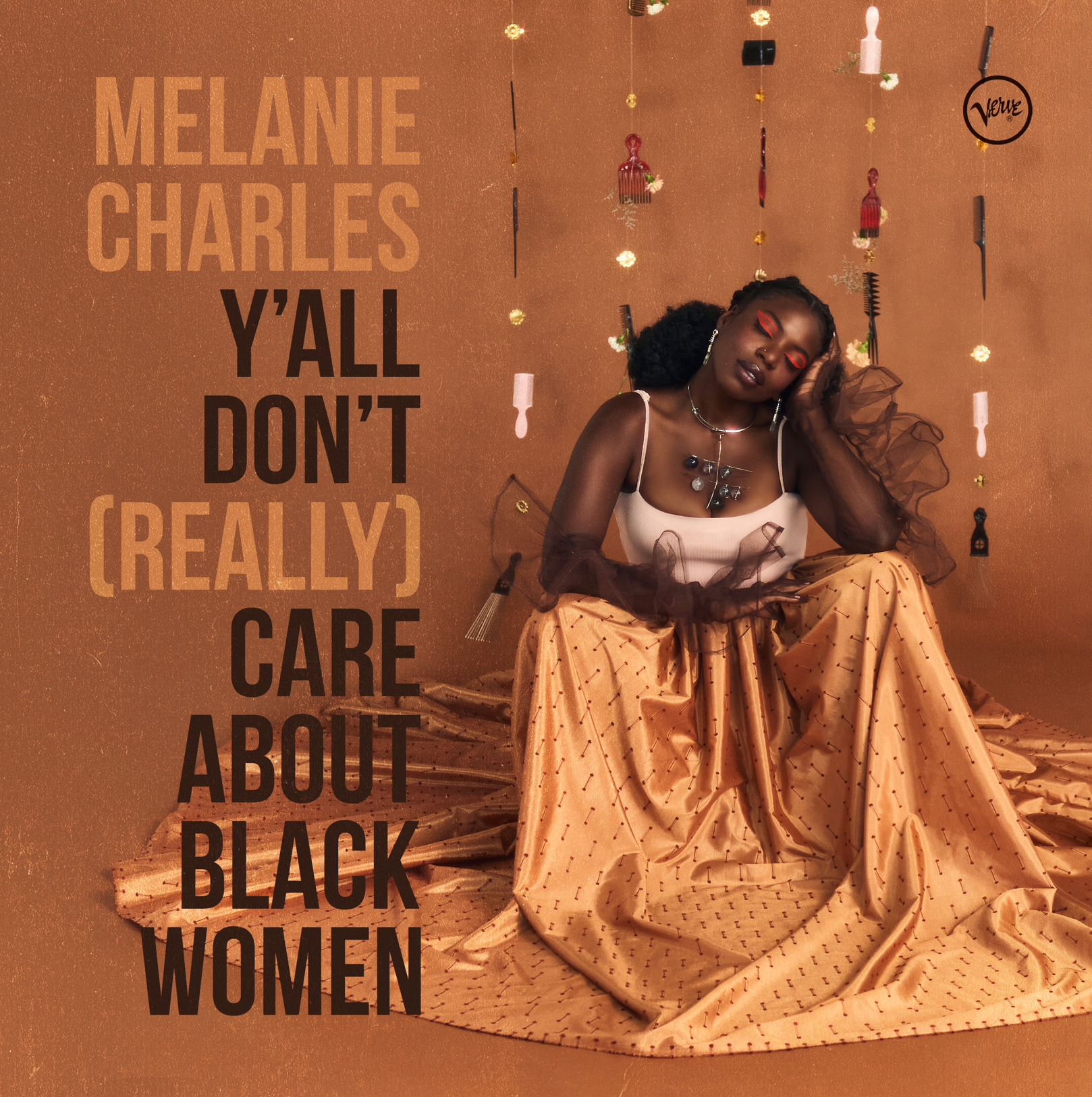
"I wanted, similar, a Prince free energy and I've never heard a version of "God Anoint the Kid" like that. In that location's also an element of daze factor a little bit too, similar, what is a different mode that we tin feel this song? That's always my intention and in the history of jazz music is that a lot of the songs were pop songs of the time that people took and made jazz versions or musical theater. So, that's e'er been part of the jazz feel and that's my whole brand jazz trill again thing— is like, how tin we sustain that idea of at that place's and so much material that is so amazing, but how tin can we feel them differently? Like, that's always been the vibe and that is definitely the approach with me reimagining the songs. Merely so there are other ones like, "Women of the Ghetto," that's a straight chop-upwards situation. Chop, chop, chop. And even "Jazz (Ain't Nothin But Soul)," the ending of like, (singing). Maybe we tin really hear this in the club."
Charles says that when she first started working on the project, she initially planned on recording with her ring inside the studio. Merely when the lockdown started, she suddenly was left having to figure out how to record an unabridged album remotely: she set her own in-home studio, bought her ain gear and even learned how to use the Logic music software. All the while, she found herself diving into the catalog and connecting with non only the records and classics, only the experiences that are reflected through them.
"I realized that the universe is ever connecting me to explore in depth what my jazz ancestors were doing," Charles says. "Louis Armstrong was probably, if you think about it, ane of the first musicians to have his home studio because bruh had cassettes, on cassettes, on cassettes, on cassettes of house recordings, him in a hotel talking well-nigh the ring. He was about that life. And so, with Y'all Don't Really Care Near Black Women, I really wanted to honor the things that all of those women have e'er been saying—women like Nina Simone, Billie Holiday."
During lockdown, Charles also discovered a newfound passion for basketball later on her childhood friend Vanessa asked her if she wanted to play. Although she'd never hooped before, Charles found that when she started playing with other female person jazz musicians in Brooklyn, who call themselves the Bushwick Globetrotters, she found herself not only discovering her love for the game, simply has found that the game has connected her within her ain community.
"I call back that brawl is such a part of the fabric of our culture, whether you play or y'all don't. Similar, I'll go to the park and shoot around and these young kids that, I might have been like, Oh these kids, they come up up to me and they're like, Hey, y'all want to shoot? It's assuasive me to connect with the real of my neighborhood and my community. I think ball for the culture, like riding effectually in Brooklyn, you see all the different types of tournaments, all the pickup games that are happening, it's everywhere. Information technology's similar a revolving unit of measurement on every block. [Information technology's] actually important to me to connect with that because I feel like as we evolve, nosotros lose sight of the importance of the civilisation. Not in a glorified way, just in the honest, everyday mode."
One of the women Charles plays with is a curator, and she invited her to put together an Open up Air bear witness. Charles knew that she wanted to comprise not only her music and sound into the performance, but to intertwine basketball game too.
"I was like, Okay, it's gonna be like a jam session. Like, Space Jam just a jam session that [connects] the tradition of improvised music with the game of ball," Charles explains. "I invited my friend Kayla Faris, she was an incredible dancer…and the dancers were sort of reenacting a basketball experience, from drills to warming upwards to passing the ball effectually. They were dressed in uniform gear, and the band, nosotros were sort of similar in suits, sort of like the management of the basketball team. I love how the structure of a band and the structure of the team is the same [and] you're simply equally strong as every member in your team. Everyone has to be killing. And, [simply like how] some musicians can play many instruments, some ballers can play many positions and they can fill in the raw, [whereas] some people, they got their specialty and you know what they're going to bring to the table. And, if y'all don't employ it, you'll lose it [type of] idea. In jazz, you got to shed you [and] practise your long tones, your scales and if y'all don't do that yous're going to sound crazy."
"I'm constantly seeing the correlation and it kind of takes off the pressure, even in the fashion I make music considering I'grand like, it'due south only like playing brawl."
Although the performance was unfortunately cancelled, the vision was all there. In the words of SLAM'south video producer Ciara Ingram, who has played pickup basketball game with Charles, Charles is a truthful indicate baby-sit—whether it's on the stage or the court, she's a facilitator and a collaborator who loves to get anybody involved. On the anthology, tracks like, "Pay Black Woman (Interlude)" are a reflection of just that: the vocal features excerpts from a curt documentary she's currently working on, titled, A Love Letter of the alphabet to Jazz Girls, and Charles included a conversation with a few creatives and close friends, including Rena Anakwe, KeyiaA and Salenta Baison, about how Blackness women are underpaid.
The vocal, and truly every runway on Y'all Don't (Really) Care Most Black Women, is not just honest and real, merely undeniably of import.
"I love bringing people together and spotting where they polish and finding ways for us to smooth together. That's my beloved language. I'm about to become emotional," Charles says. "That's all I care about—how can nosotros be dope together? I accept friends who came to America from Cuba and they're like, Melanie, you gave me my first gig. And information technology'south similar, Bro, considering you lot kill information technology. Let's go, permit's play music. Even when you play brawl, you play music, we're all playing. And if we vibe, we vibin'. I guess I am a betoken guard in my life and on the stage. Let's be together, let's practice some sh*t."
You can stream Y'all Don't (Really) Care About Black Women here.
Photo via Getty Images and Melanie Charles MGMT.
Source: https://www.slamonline.com/the-magazine/the-jazz-point-guard-melanie-charles-is-intertwining-jazz-with-her-love-for-hoops/
0 Response to "Melanie Charless Make Jazz Trill Again Project"
Enregistrer un commentaire